

『Emmeti Flow Meter Balancing: Adjusting Underfloor Heating Manifold Flow Rates』Related information(v cone flow meter|rotary gas meter|gallon meter|gear meter|metal tube rotameter|glass tube rotameter|nutating disk meter|transit time ultrasonic flow meter|wedge flow meter|pd meters|hydraulic flow meter|ultrasonic water flow meter|water flow meter|air flow meter|magnetic water flow meter|oxygen flow meter|gas flow meter|argon flow meter|air velocity meter|gasoline flow meter|fuel flow meter|ultrasonic water meter|digital water meter|nitrogen flow meter|solid flow meter|Oxygen tank flow meter|digital water flow meter|diesel fuel flow meter|steam flow meter|02 flow meter|compressed air flow meter|oil flow meter|liquid flow meter)
Emmeti Flow Meter Balancing: Adjusting Underfloor Heating Manifold Flow Rates
Quick Answer: Balancing an Emmeti underfloor heating manifold means setting each loop flow meter to the design flow rate, often 0.5 to 3.0 L/min for a residential loop. Start with stable supply water temperature and manifold pressure. After adjustment, check the return temperature and correct any loop that deviates more than 10 percent from target.
Why Balanced Flow Rates Prevent Cold Rooms and High Energy Bills
Underfloor heating systems have loops of different lengths. A short bathroom loop may need 0.8 L/min. A long living room loop may need 2.5 L/min. If every Emmeti flow meter is fully open, the short loops steal water from the longer loops. The pump also runs with uneven return temperatures. Balanced flow rates correct this at the manifold.
A healthy loop usually shows a delta T between 7 and 15 °C. Delta T above 20 °C means flow is too low. Delta T below 5 °C means flow is too high or the loop is short. We have seen this on a villa in Perth where a 6 square metre bathroom reached 31 °C while a 38 square metre living room stayed at 22 °C. After setting the Emmeti flow meters to design values, both zones stabilised within 24 hours.
What You Need Before Adjusting an Emmeti Flow Meter
Do not start with the flow meters first. Set the mixing valve to deliver 35 to 45 °C supply water. Check that the manifold pressure is stable between 0.5 and 1.5 bar when the pump runs. Air in the loops will make the float bounce. A bouncing float gives a false reading.
Basic tools include a flat screwdriver for the flow meter collar, an infrared thermometer, and a notepad. Some Emmeti flow meters use a knurled ring instead of a screw. Turn the ring slowly. The float needs 5 to 10 seconds to settle after each change. If the sight tube is coated with sludge or iron oxide, flush the loops first.
Step by Step: Setting Loop Flow Rates on an Emmeti Manifold
Label each loop first. Record the room name, loop length, pipe size, and design flow rate. Typical pipe sizes are DN16 or DN20. If design data is lost, start at 1.5 L/min for loops up to 80 metres and 2.0 L/min for loops up to 110 metres.
Open all zone actuators fully and let the pump run for 15 minutes. Vent air at the manifold. A stable float on the Emmeti flow meter means the loop is ready to read.
Find the loop with the highest flow after stabilisation. Use this loop as the reference. Reduce flow on shorter loops first. Turn the flow meter collar clockwise to reduce flow. Wait 10 seconds. Read the new value. A quarter turn can change flow by 0.3 to 0.5 L/min on some Emmeti models. Adjust all loops close to target, then go back to the first loop. Changing one loop affects manifold pressure and shifts the other readings.
After 10 minutes, measure pipe surface temperature at the flow and return connections. Do not use floor surface temperature because the slab stores heat. The return temperature should often be 5 to 10 °C below the supply temperature for residential systems. Lock or mark the setting when the loop is stable. Replace a flow meter that drifts after one heating season.
Common Flow Rate Readings and Their Practical Limits
Many Emmeti flow meters have a transparent tube with a red flo
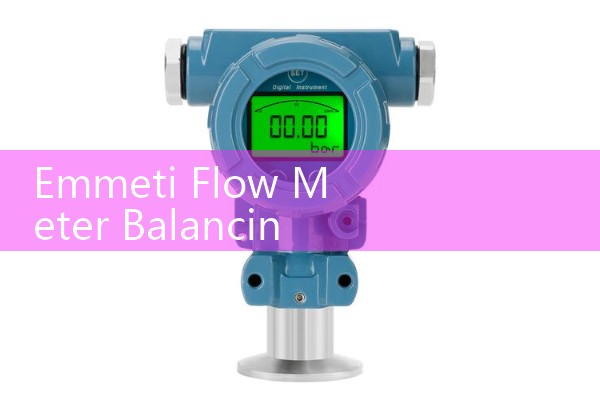
For commercial floors, individual loops may run at 3.0 to 5.0 L/min. A plastic sight tube is not a precision instrument. Expect an accuracy of around plus or minus 5 percent of full scale when clean. If the job requires better than 2 percent, use a Silver Instruments electromagnetic flow meter for verification. Some HVAC contractors in Singapore and Dubai use a clamp-on ultrasonic flow meter before final commissioning to check the manifold readings without cutting pipe.
How Silver Instruments Flow Meters Support Manifold Balancing
Silver Automation Instruments supplies electromagnetic flow meters for water and heating water circuits from DN15 to DN50. The meters have no moving parts and do not depend on a transparent tube or float. The display shows flow rate, total volume, and temperature if the model includes a PT100 input. Output options include 4-20 mA HART and RS485 for building management systems.
An Emmeti flow meter works well for local loop adjustment. It is not a remote monitoring device. An inline electromagnetic flow meter from Silver Instruments on the main supply header gives a stable total flow reference. If the header total matches the sum of the loop flow meters, manifold condition is good. If the numbers diverge, check for bypass leaks, air, or a stuck float.
FAQ on Emmeti Flow Meter Balancing
What flow rate should I set on each Emmeti flow meter? Use the design loop flow rate. For most residential loops this is 0.5 to 3.0 L/min. If design data is missing, start at 1.5 L/min for loops up to 80 metres and adjust based on delta T.
Why does the float in my Emmeti flow meter keep dropping? Air in the loop, low manifold pressure, or a dirty restrictor are common causes. Vent the manifold, check the pump, and clean or replace the flow meter body.
Can I balance the manifold without a flow meter? You can use pipe surface temperature and return water temperature, but it is slower. Flow meters give direct readings and reduce overcorrection.
How often should the Emmeti flow meters be checked? Once per heating season is enough for most homes. For commercial systems, check at the start of each season and after any actuator or pump replacement.
When should I replace the Emmeti flow meter with an inline electromagnetic flow meter? Replace or supplement it when you need remote monitoring, total flow data, alarm output, or accuracy better than 5 percent. Silver Instruments electromagnetic flow meters fit DN15 to DN50 heating water lines and output standard 4-20 mA HART signals.
Request a flow meter selection for your underfloor heating manifold. Send the loop lengths, pipe size in DN, water supply temperature in °C, and required flow rate for each zone. We recommend a compact Silver Instruments electromagnetic flow meter for the main header or a replacement local flow meter if needed. Tel: +86-25-68650347. WhatsApp: +86-25-52155837. WeChat: +86 15365082610.
 Hot News
 Related AD