

『Gas flow meters must use vortex street technology』Related information(v cone flow meter|rotary gas meter|gallon meter|gear meter|metal tube rotameter|glass tube rotameter|nutating disk meter|transit time ultrasonic flow meter|wedge flow meter|pd meters|hydraulic flow meter|ultrasonic water flow meter|water flow meter|air flow meter|magnetic water flow meter|oxygen flow meter|gas flow meter|argon flow meter|air velocity meter|gasoline flow meter|fuel flow meter|ultrasonic water meter|digital water meter|nitrogen flow meter|solid flow meter|Oxygen tank flow meter|digital water flow meter|diesel fuel flow meter|steam flow meter|02 flow meter|compressed air flow meter|oil flow meter|liquid flow meter)
1. What type of flowmeter should be selected for different density media? The type of flowmeter suitable for different density media mainly depends on the characteristics of the media and measurement requirements. High density media usually require a more robust design and higher pressure tolerance Low density media (such as gases and low viscosity liquids) • Thermal mass flowmeter: directly measures gas mass flow rate with high accuracy of ± 1%, suitable for natural gas and compressed air • Turbine flowmeter: accuracy level 0.5, suitable for clean low viscosity liquids (density<800kg/m ³), low pressure loss • Vortex flowmeter: suitable for gases with a density range of 0.5-2.5kg/m ³, pressure resistance up to 4.0MPa 2. Medium density media (water, chemical solutions) • Electromagnetic flowmeter: requires conductivity>5 μ S/cm, accuracy level 0.3, completely unaffected by density changes • Ultrasonic flowmeter: external clamp type suitable for liquids with a density of 800-1200kg/m ³, measurement error<1.5% • Coriolis mass flowmeter: directly measures mass flow rate, density Measurement range 0.2-3.5g/cm ³, accuracy 0.1% 3 High density media (slurry, ore slurry, heavy oil) • Wedge flowmeter: specially designed for high viscosity and solid particle media, capable of withstanding slurry with a density greater than 2000kg/m ³ • Metal tube rotor flowmeter: suitable for high viscosity fluids with a density of 1.5-3.0g/cm ³ and a pressure resistance of 6.3MPa • Non full tube electromagnetic flowmeter: used for slurry containing solid particles, with a permissible filling degree of 10% -100% Density changing medium • Dual channel ultrasonic flowmeter: compensates for density effects through changes in sound velocity, suitab
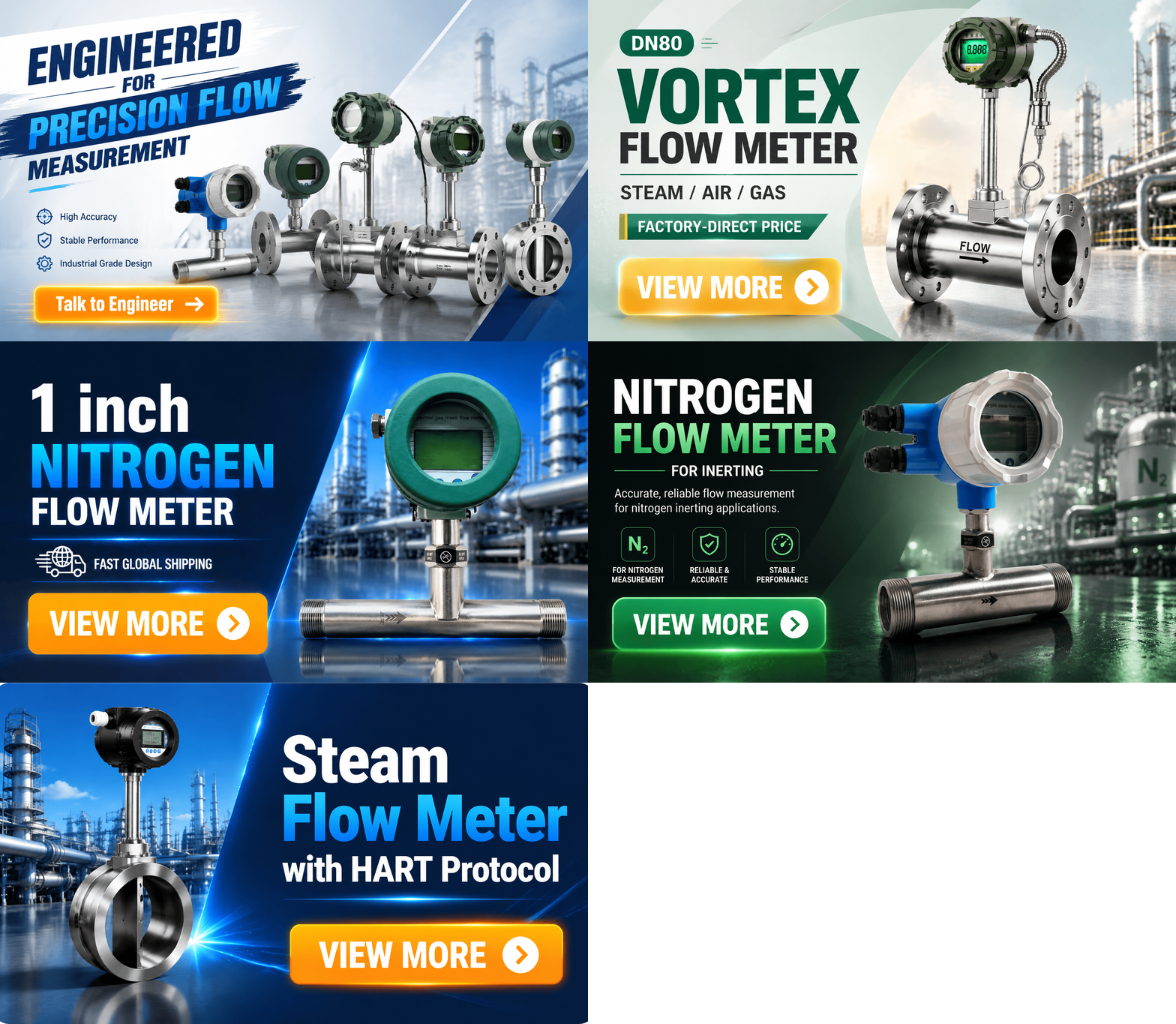
2. Which type of flow meter is used for steam measurement? The commonly used flow meters for measuring steam include balance orifice flow meters and vortex flow meters. Among them, vortex flow meters have become the more favored choice due to their advantages of small pressure loss, simple structure, and easy installation. The following introduces the measurement principle, selection, and application scenarios of the vortex flowmeter: The vortex flowmeter is designed based on the Karman vortex principle, and calculates the flow rate by measuring the vortex frequency generated by fluid oscillation. The specific process is as follows: Vortex generation: When the fluid flows through the vortex flowmeter, the triangular column vortex generator will alternately generate two columns of vortices in the fluid, and the release frequency of the vortices is related to the average flow velocity of the fluid and the characteristic width of the vortex generator. Frequency measurement and flow calculation: By detecting the frequency of vortex release through sensors and combining it with parameters such as fluid density, the average velocity, instantaneous flow rate, and cumulative volume of the fluid can be calculated. The selection points of vortex flowmeter are 『SILVER Official Website SERVICE』
 Hot News
 Related AD