

『Biodiesel Flow Meter 5 m3/h Blending Terminal Verification Methods』Related information(v cone flow meter|rotary gas meter|gallon meter|gear meter|metal tube rotameter|glass tube rotameter|nutating disk meter|transit time ultrasonic flow meter|wedge flow meter|pd meters|hydraulic flow meter|ultrasonic water flow meter|water flow meter|air flow meter|magnetic water flow meter|oxygen flow meter|gas flow meter|argon flow meter|air velocity meter|gasoline flow meter|fuel flow meter|ultrasonic water meter|digital water meter|nitrogen flow meter|solid flow meter|Oxygen tank flow meter|digital water flow meter|diesel fuel flow meter|steam flow meter|02 flow meter|compressed air flow meter|oil flow meter|liquid flow meter)
Biodiesel Flow Meter 5 m³/h Blending Terminal Verification Methods
Quick Answer: Inline verification with a calibrated master flow meter is the most practical method for a 5 m³/h biodiesel blending terminal. A Coriolis mass flow meter from Silver Instruments gives you direct mass, density, and temperature readings with ±0.2% accuracy. Send us your pipe size, pressure, and temperature and we will recommend a SIL-COR series model that fits your blend ratio verification setup.
Why You Need Verification at a Biodiesel Blending Terminal
Biodiesel blending terminals mix pure biodiesel (B100) with petrodiesel to reach a target ratio, often B5, B10, or B20. If the flow meter drifts by 1%, the blend ratio shifts. A 5 m³/h line produces about 120 cubic meters per day. A small error adds up to hundreds of liters of off-spec fuel each week. Most terminals run inline verification every batch or every shift. This catches drift before the blend goes into the storage tank.
In Southeast Asia, a biodiesel plant in Johor, Malaysia, found that their positive displacement meter drifted after six months of use. The B100 feedstock contained trace glycerin that built up on the rotors. The plant switched to a Coriolis meter from Silver Instruments with a PTFE lining. After that, inline verification against a certified master meter took less than 20 minutes per week and the plant stopped making out-of-spec blends.
Typical Verification Methods for a 5 m³/h Line
Engineers at blending terminals usually pick one of three methods. The first is inline comparison with a master meter. You pipe a reference flow meter in series with the process meter and compare their outputs for the same batch. The second method is gravimetric. You divert flow into a weigh tank and check the total mass against the meter totalizer. This method is accurate but hard to set up on a live blending skid. The third method is a portable prover. This works for truck loading racks but not for a fixed 5 m³/h blending line.
At 5 m³/h, the flow is too low for many compact provers. A weigh tank of 500 liters works, but it requires space and downtime. Most terminals in Latin America and the Middle East prefer the inline master meter method. You install a second Coriolis meter with a higher accuracy class, leave it in the line for one batch, and compare cumulative mass totals. If the difference is under 0.3%, the process meter passes.
How to Set Up an Inline Master Meter Verification
We have seen this done many times on customer sites. You need a master meter with better accuracy than the process meter. For a 5 m³/h biodiesel line, the master meter should be a Coriolis mass flow meter with ±0.1% or ±0.15% accuracy. Size it for the same flow range. A DN15 or DN20 sensor usually handles 5 m³/h for biodiesel (density around 880 kg/m³). Pipe it in series right after the process meter, with at least 10 pipe diameters of straight run before the master meter.
During the verification run, you fill a batch of at least 500 kg of B100 or blended product. Read the totalized mass from both meters simultaneously via 4-20 mA HART or Modbus. Compare the two totalizer values. Many engineers also log the density from both meters during the run. If the density readings match within 2 kg/m³, you know there is no air in the line. Air causes the single biggest error in biodiesel blending verification. A Coriolis meter from Silver Instruments measures density directly, so you spot air ingress fast.
Silver Instruments Flow Meter Options for Biodiesel Blending
We supply the SIL-COR series Coriolis mass flow meter in sizes from DN3 to DN150. For a 5 m³/h biodiesel line, the most common choice is the SIL-COR25A (DN25) with stainless steel wetted parts and PTFE lining option. This model gives you mass flow, volumetric flow (calculated from density), density, and temperature on one output. Process connections
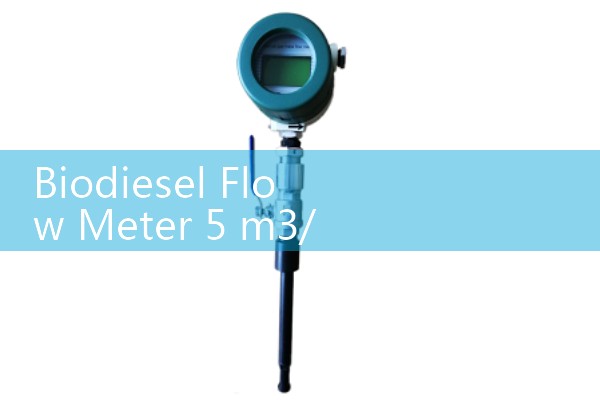
A factory in Brazil uses the SIL-COR15A (DN15) for their B20 blending terminal. The flow rate there is 4.5 m³/h of B100 into a 6-inch header. The meter sits in an ATEX Zone 1 area. They run inline verification once a week using a portable master meter we supplied as a complete skid. Total verification time is 15 minutes. In practice, the density value from the meter also helps the operator check blend quality in real time.
If your application needs a simpler meter, we also offer oval gear flow meters with pulse output. The SIL-OG series works for clean biodiesel at stable viscosity. But we find that most blending terminals in Africa and Oceania prefer the Coriolis type because it ignores viscosity shifts and needs no regular mechanical adjustment.
Practical Details for a 5 m³/h Verification Run
Most engineers skip this part until they face it in the field. Before you run a verification, flush the line with product for 5 minutes. This removes any settled glycerin from the process meter. Set the master meter zero. Then start the batch run at the normal blending flow rate, usually 4.5 to 5.5 m³/h. Do not stop and start during the run because that creates turbulence and air pockets. Log the totalized mass from both meters once per minute for at least 10 minutes. At the end, compare the totals. A pass criterion of ±0.3% of reading is typical for biodiesel blending in the Middle East and Latin America. In Australia, some terminals tighten this to ±0.2% when blending for government contracts.
Temperature compensation does matter. Biodiesel density changes about 0.7 kg/m³ per °C. If the process meter does not measure density, you must compensate volumetric flow manually. But a Coriolis meter from Silver Instruments outputs mass flow and density directly, so temperature compensation is built in. That cuts out one source of error during verification.
FAQ
Q: Can I use an oval gear flow meter for biodiesel blending verification?
A: Yes, if the biodiesel is clean and temperature is stable. But oval gear meters drift with viscosity change. B100 viscosity changes a lot between 20°C and 40°C. A Coriolis meter gives stable readings across that range and measures density too. Most blending terminals choose Coriolis for the master meter role.
Q: How often should I verify the flow meter at a 5 m³/h blending terminal?
A: We see customers do inline verification once per shift or once per day. If the blend is critical, like for a government fuel contract, once per batch is safer. After a major maintenance job, run two verification batches back to back.
Q: What output signals does the SIL-COR meter offer for verification systems?
A: The standard transmitter has 4-20 mA HART, a pulse output, and Modbus RTU. You can pull mass total and density via Modbus into your terminal PLC. The pulse output works well for totalizer comparison modules on the blending skid.
Q: Do I need ATEX certification for the master meter?
A: Most biodiesel blending terminals are in Zone 1 or Zone 2. Silver Instruments supplies SIL-COR meters with ATEX, IECEx, or NEC certification as needed. Just tell us your zone classification when you ask for a quote.
Q: What is the lead time for a SIL-COR meter with a verification skid?
A: Standard models in DN15 to DN25 usually ship in 2 to 3 weeks. A complete verification skid with piping and a portable master meter takes 5 to 6 weeks. We ship to Southeast Asia, Latin America, Africa, the Middle East, and Oceania from our logistics center.
Send us your pressure (bar), temperature (°C), pipe size (DN), and flow range. Tell us if you need a process meter, a master meter for verification, or a full skid. We will propose a SIL-COR or SIL-OG flow meter with the right accuracy class for your biodiesel blending terminal.
 Hot Blog
 Related AD