

 Current position >About Us
Flow Meter Humidifier Calibration: Regulating Micro-Dosing Feeds for Commercial HVAC
Quick Answer
Humidifier feed systems in commercial HVAC often run at flow rates below 20 kg/h. That is too low for most general purpose flow meters. You need a meter sized for micro-dosing with repeatability better than 0.3% and a turndown ratio of at least 50:1. Send us your water pressure, pipe size, minimum flow rate, and target humidity range and we will recommend a specific model.
Why Humidifier Calibration Fails Without the Right Flow Meter
Most HVAC humidifiers inject water or steam into air handling units in short pulses. Each pulse lasts between 2 and 15 seconds. The volume per pulse is small. In some commercial systems we have seen individual doses as low as 0.2 liters. A standard paddle wheel meter or a cheap rotameter cannot catch those short pulses. The result is drift in humidity setpoint. The building management system thinks it added 0.5 liters but the actual dose was 0.3 or 0.7 liters.
We have seen this on customer sites in Singapore, Dubai, and Mexico City. The symptom is simple. Zone humidity oscillates. The BMS logs show good control signals. But the actual room sensors do not match. The first place to check is the flow meter on the humidifier feed line. Not the control valve. Not the humidity sensor. The flow meter.
Flow Meter Selection for Micro-Dosing Humidifier Feeds
Commercial HVAC humidifier feed lines usually use pipe sizes from DN10 to DN25. Operating pressure sits between 1 and 6 bar. Water temperature is normally 5 to 25 °C. The flow range during a dosing pulse can be 2 to 50 kg/h. That is small. In practice most engineers skip this part and select a meter based on pipe diameter alone. That leads to poor low flow accuracy.
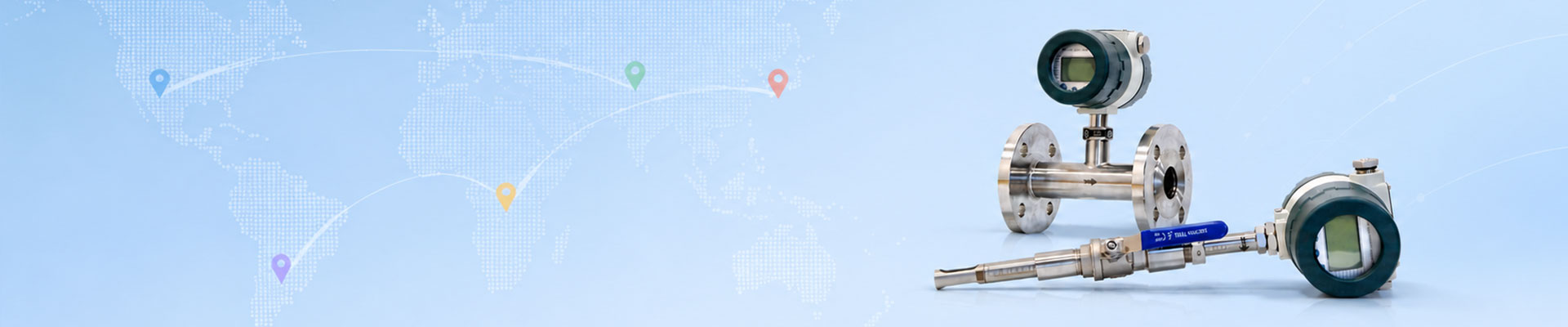
For micro-dosing water feed lines we recommend two options. A small electromagnetic flow meter works well for conductive water. Model range DN10 to DN15. Accuracy is typically 0.2% to 0.5% of reading above 1 kg/h. Output options include 4 to 20 mA HART or pulse. Repeatability is 0.1% which matters more than absolute accuracy for humidity control. The meter has no moving parts. That is useful because humidifier feed water often carries mineral particles.
For non-conductive water or very low flow below 1 kg/h, a thermal mass flow meter is a better fit. Thermal meters measure actual mass flow directly. No need for separate temperature compensation. We have supplied thermal meters for a pharmaceutical facility in Ho Chi Minh City that required dosing accuracy of 0.05 kg per pulse. The meter was a DN6 insertion thermal type with a local display and 4 to 20 mA output.
Oval gear flow meters also work for clean water micro-dosing. They are positive displacement meters. Each gear rotation equals a fixed volume. This gives very high repeatability at low flow. A DN4 oval gear meter can measure 0.5 to 30 kg/h with 0.5% accuracy. But they do not like dirty water. If your humidifier supply line has sediment or scale particles, avoid oval gear meters.
Calibration Considerations for Dosing Accuracy
Factory calibration on a flow bench is not enough for humidifier micro-dosing. The calibration lab usually tests at steady flow. But humidifier feeds are pulsed. The meter must respond fast enough to capture the rising and falling edge of each dose. Many electromagnetic meters have a damping setting. Default damping of 5 seconds will smooth out a 3 second pulse. The meter will report a flow that never reaches the true peak. Totalized volume per dose will read low.
Here is the thing. You must set the damping to 0.5 seconds or less for pulse dosing. Most engineers skip this part. Then they wonder why the BMS shows poor humidifier performance. We have seen this on customer sites many times. A simple damping adjustment fixed the reading without replacing any hardware.
Temperature