

 Current position >About Us
Flow Meter Air Tools: Professional Gas Velocity and Mass Tracking Hardware
Quick Answer: A flow meter for air tools measures gas velocity and mass flow directly in compressed air lines. Silver Automation Instruments supplies thermal mass and vortex meters for DN15 to DN200 pipes. These meters output kg/h, Nm3/h, m/s, and 4-20 mA HART data for real time monitoring and totalized mass tracking.
Here is the thing. Most compressed air systems have pressure gauges but no flow data. A pressure gauge will not tell you how much air a spray gun or impact wrench consumes. A flow meter air tools hardware package from Silver Instruments fills that gap. You see the gas velocity, mass flow, and total consumption per branch line before and after tool changes.
We have seen this many times on customer sites. A paint manufacturer in Southeast Asia had one DN25 branch line feeding six air sanders. The line ran 24 hours a day. A thermal mass meter showed 18 Nm3/h during lunch break when no tool should run. The plant found a cracked hose fitting. That single leak was equal to 11 percent of the compressor output.
Why Gas Velocity and Mass Tracking Matter for Air Tools
Pneumatic tools do not consume air at a constant rate. Impact wrenches use short bursts. Grinders run steady but under variable load. Blow guns bleed air even when idle. Pressure alone cannot show these patterns. Mass flow and gas velocity do.
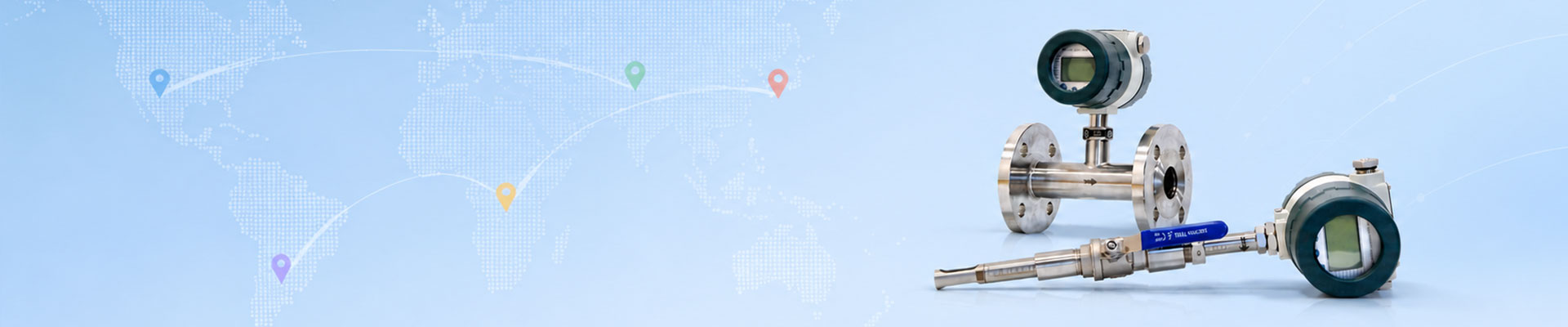
In practice, a thermal mass flow meter gives direct kg/h or Nm3/h output. It uses a heated sensor and a PT100 reference. The cooling effect of gas moving across the sensor is converted into mass flow. This works well for clean compressed air and nitrogen lines from DN15 to DN80. For larger headers, an insertion probe can reduce total hardware cost.
Recommended Meters for Compressed Air Tools
Silver Instruments recommends two main types for air tool flow measurement. The first is a thermal mass flow meter. It is a good match for DN15 to DN100 branch lines where you need low pressure drop and direct mass units. The second is a vortex flow meter. It suits DN40 to DN200 headers and can handle small oil mist better than a thermal probe.
Both meter types can be supplied with 4-20 mA HART, pulse, or RS485 Modbus output. Accuracy for compressed air service is typically 1.5 percent of reading for thermal mass and 1.0 percent of reading for vortex. Turndown can be 100 to 1 on a thermal mass probe. That helps when you track both idle flow and full load flow on the same tool line.
For hazardous area workshops, ask for the ATEX Zone 1 version before the order. This is common in paint booths, solvent storage areas, and offshore maintenance decks. If your air is wet or oily, tell us. That affects sensor selection.
Installation Notes Without the Guesswork
Most engineers skip this part. They install a meter after an elbow or valve without enough straight run. The reading becomes noisy. For a reliable gas velocity signal, keep 10 diameters of straight pipe upstream and 5 diameters downstream. Use a ball valve for hot tap insertion. That lets you service the probe without shutting down the air line.
Because compressed air can carry water and oil aerosol, install a filter or moisture separator upstream if the air quality is low. Thermal mass sensors can drift if oil coats the heated element. Vortex meters tolerate small droplets better. But neither meter works well with slug flow or heavy liquid carryover.
What Parameters to Send for a Firm Quote
Send us your pipe size in DN, air pressure in bar, air temperature in °C, flow range in kg/h or Nm3/h, and signal type. A typical inquiry looks like this: DN50 pipe, 7 bar air, 25 °C, 10 to 400 Nm3/h, 4-20 mA HART output. That is enough for a specific model and price.
If you measure multiple tool drops, tell us how many points you need. We can size insertion meters for each branch and one vort